Applying AWS CAF in SMBs: A Practical Path to Cloud Readiness
 by Bakican Aksoy
17 Kasım 20268 min read
by Bakican Aksoy


A small engineering team can provision AWS resources quickly. Deciding who approves access, how spending is reviewed, and what happens during an outage takes a different kind of preparation. As more workloads move to the cloud, these decisions become part of everyday business operations.
For many small and medium-sized businesses (SMBs), limited specialist capacity makes this preparation particularly important. The same people may develop applications, manage infrastructure, and respond to incidents. Each new technology adds responsibilities that compete for their time.
The AWS Cloud Adoption Framework (AWS CAF) helps leaders consider these responsibilities together. For an SMB, its value lies in connecting business priorities with the capabilities needed to deliver them. Applied thoughtfully, it gives a small team a practical way to decide what to improve first and how to verify that those improvements are working.
AWS CAF organizes cloud readiness into six perspectives: Business, People, Governance, Platform, Security, and Operations. Together, they cover the organizational and technical capabilities needed to create value through the cloud.
In an SMB, several perspectives may sit with the same team. A CTO might coordinate platform decisions and security priorities while working with finance on spending and with operations on continuity requirements. The goal is not to create more process; it is to make ownership, decision authority, and available capacity clear.
AWS recommends developing capabilities incrementally through its cloud transformation journey. Review all six perspectives, identify the gaps that matter to the next initiative, and turn them into a focused improvement backlog. For each priority, record the decision, its owner, and the evidence that will show whether it works.
If the next initiative is a migration, Sufle’s step-by-step AWS migration guide provides a practical continuation from readiness decisions to migration planning.
The Business perspective connects cloud investment with business outcomes. A useful starting point is one operational constraint: delayed releases, recurring service interruptions, or infrastructure work that keeps engineers from improving the product.
Translate that constraint into a measurable objective. If releases take too long, establish the current lead time and identify the steps causing delays. Then evaluate whether automation, application changes, or a different operating model would address the underlying constraint.
Build the business case around the full cost of change, including AWS consumption, migration effort, training, support, and ongoing engineering time. A managed service may have a higher direct service charge yet still reduce total operating effort. Capture the decision in a short brief that the business sponsor and technical owner can revisit as the initiative develops.
The People perspective covers leadership, skills, culture, and organizational change. In a small team, one of the most important questions is whether essential operations depend on a single person’s availability.
Document who owns each workload, who can provide cover, and which skills the next initiative requires. Create practical learning opportunities through deployment reviews, recovery exercises, and paired infrastructure changes. Training alone cannot solve a capacity problem, so leadership also needs to reserve time for new practices.
External specialists can close capability gaps, but the business should retain an internal owner for priorities, access decisions, and provider relationships. A simple test is to ask a second authorized team member to complete a routine deployment or recovery exercise using the documented procedure.
The Governance perspective brings together financial management, risk, and the realization of business value. An SMB can begin with a regular review involving engineering and finance, supported by a clear view of costs by workload and environment.
Define who can authorize new spending, how resources are attributed, and when a cost change requires investigation. Use a consistent tagging strategy and activate the relevant cost allocation tags for billing analysis.
AWS Budgets can alert teams to actual or forecast spending, but budget notifications depend on updated billing data and should not be treated as a real-time spending cap. Assign an owner to each alert and agree on the appropriate response. Review spending alongside usage and business outcomes: a higher bill may reflect growth, waste, or a deliberate reliability improvement.
For practical next steps, see Sufle’s AWS cost optimization guide.
The Platform perspective covers the environment and delivery capabilities that support workloads. For an SMB, the priority is a foundation that engineers can understand, reproduce, and maintain.
Separate production from development and testing through an appropriate AWS account structure, and keep application workloads out of the organization’s management account. AWS recommends starting with a suitable subset of accounts and expanding as requirements develop.
Use infrastructure as code for repeatable provisioning and establish a deployment approach with review and rollback procedures. Standardization should remove repeated decisions. A reusable environment definition with agreed access and logging settings keeps teams from rediscovering the same requirements for every project.
Security priorities should reflect the data a business handles and the impact of compromise. A small company that processes sensitive customer information may need substantial controls despite having a limited workforce.
Start with accountable access. AWS recommends federated access and temporary credentials for human users, IAM roles for workloads, MFA, and least-privilege permissions. Protect the AWS account root user and reserve it for tasks that specifically require root credentials.
Define requirements for data protection, audit logging, vulnerability management, and incident response. Include relevant customer, contractual, and regulatory obligations, review access regularly, and rehearse the response procedure so the team can confirm that the controls work in practice.
The Operations perspective connects service delivery with business expectations. Start with the customer journeys that matter, how failures will be detected, and who has the authority and knowledge to respond.
Monitor application behavior as well as infrastructure health. A server can appear healthy while users cannot complete an order. Alerts should point to an actionable problem and reach someone who can investigate it.
RTO (Recovery Time Objective): the maximum acceptable time to restore a service after disruption.
RPO (Recovery Point Objective): the maximum acceptable data loss, measured in time.
Test recovery against these objectives and confirm that both the application and restored data are usable. AWS recommends periodic recovery testing. Record results, unresolved gaps, and the actions required to meet the agreed objectives.
Once responsibilities are visible, the next decision is sequencing. Begin with gaps that expose critical systems or sensitive data, prevent recovery, or leave relevant obligations unmet. These issues may need to be resolved before a workload enters production.
Next, prioritize improvements that remove recurring constraints. If every deployment requires manual infrastructure changes, repeatable provisioning and release practices can free capacity across several projects. If no one can explain a spending increase, cost attribution and review ownership need attention before further expansion.
Keep the active backlog small enough to resource properly. Assign owners and completion evidence, then review progress alongside normal delivery work.
Use AWS CAF together with the AWS Well-Architected Framework. CAF helps leaders develop organizational readiness, while Well-Architected evaluates the design and operation of individual workloads. Findings from a workload review can reveal broader gaps, such as unclear recovery ownership or inconsistent deployment practices. Sufle can support this evaluation through an AWS Well-Architected Review.
Consider an SMB that operates a customer portal. Its engineers spend significant time preparing releases, while the CTO wants faster delivery without compromising service availability. A focused initiative could improve the release process for one bounded portal component.
Business Sponsor: defines the desired outcome, baseline, and success criteria.
Engineering Lead: identifies the required skills and reserves implementation capacity.
Engineering and Finance: agree on expected running costs and the review process.
The team creates a repeatable deployment path, reviews permissions, and establishes monitoring and rollback procedures. Before a controlled production pilot, it confirms that support and recovery arrangements meet the component’s requirements.
The outcome review brings release lead time, failed changes, operating effort, and costs together. Faster releases accompanied by more incidents would require further work. A higher service bill accompanied by less maintenance may be justified by the overall business case. This is how the six perspectives become useful together: they connect one business outcome with the people, controls, and technical capabilities needed to sustain it.
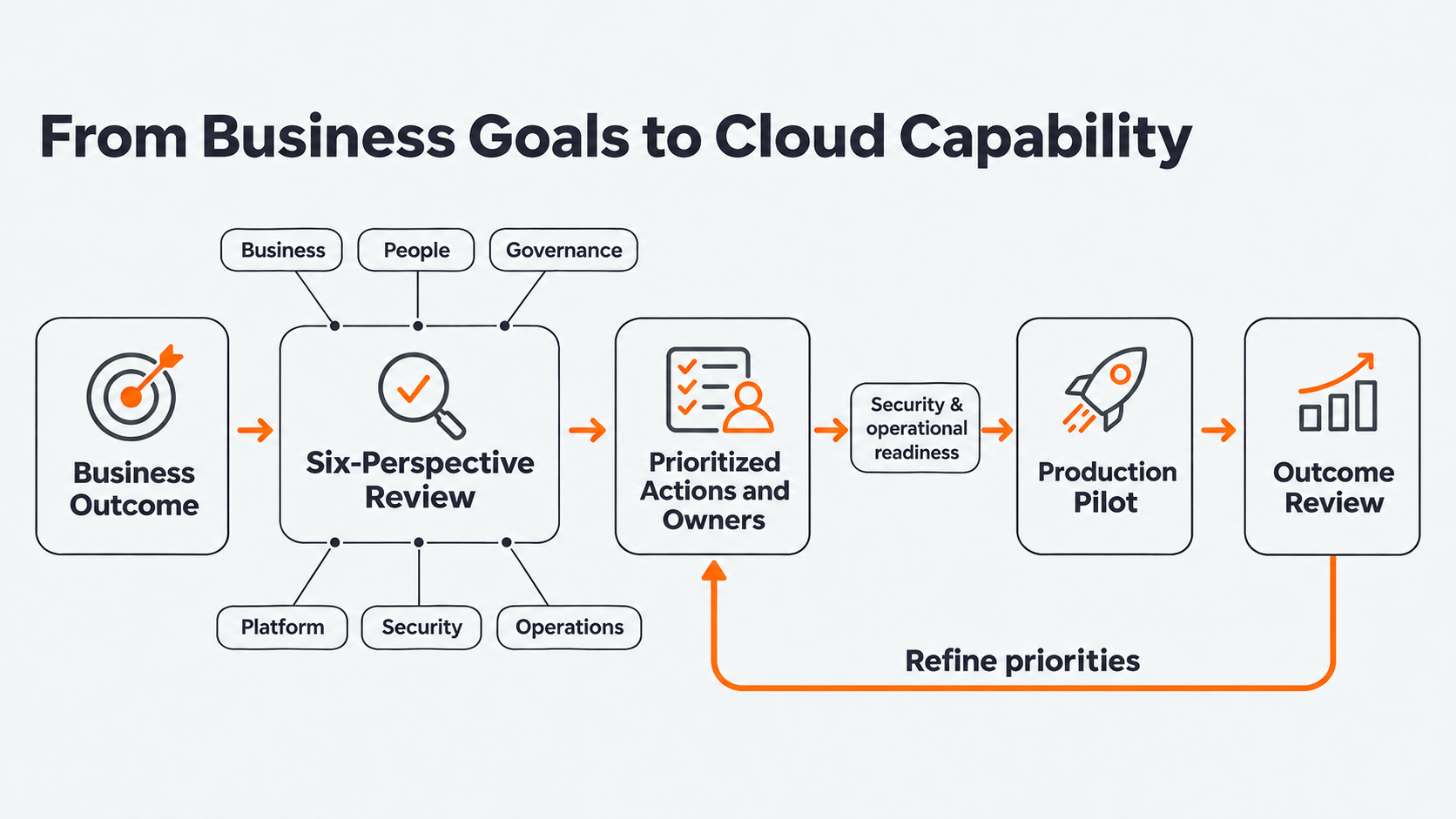
An SMB can apply AWS CAF by connecting one business outcome with capability gaps, accountable actions, and evidence from a controlled production pilot.
AWS CAF describes four iterative phases: Envision, Align, Launch, and Scale. The outputs below adapt that cycle to the practical needs of an SMB.
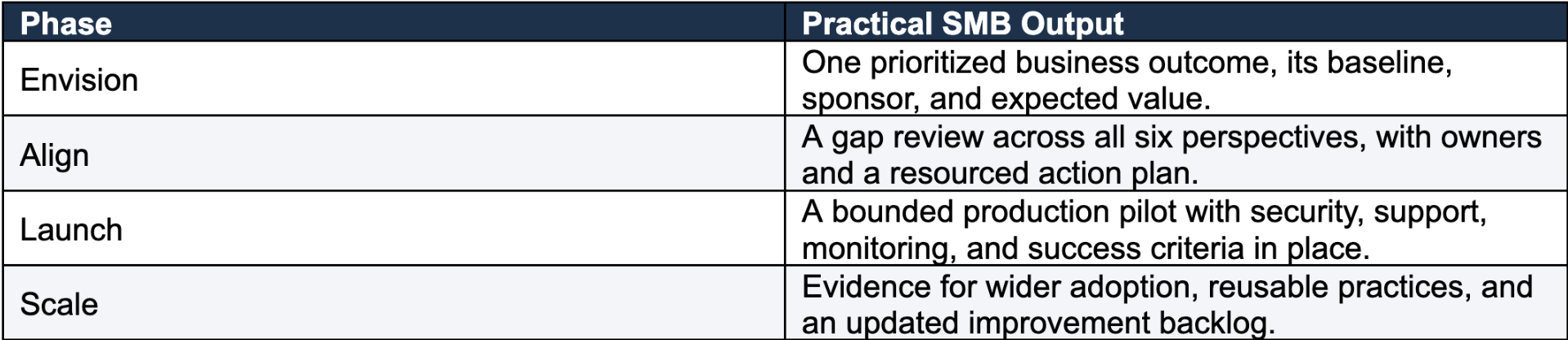
Scale may mean extending a successful practice to another workload. Revisit earlier decisions as customer needs, risks, and team capacity change.
For an SMB Technology Leader, a practical next step is to choose one cloud initiative and review its readiness across all six perspectives with the people who own the outcome. Turn the most consequential gaps into assigned work and agree on the evidence that will demonstrate progress. This connects cloud investment to business priorities and creates practices the team can sustain as it grows.
Sufle’s cloud services support cloud readiness assessments, architecture planning, and operational improvement. If you are evaluating your next initiative, contact our team to discuss your priorities and constraints.

Ready to improve your cloud readiness and build a more sustainable cloud strategy? Book an Appointment to assess your cloud capabilities and take the next step towards cloud maturity!

I’m a Business Development Specialist at Sufle, focusing on AWS partnerships, cloud technologies, and strategic business development. I’ve actively contributed to Sufle’s journey toward achieving key AWS partner designations, including MSP, Data Competency, and other AWS specializations. With a background in management engineering and entrepreneurship, I’m passionate about bridging technology and business strategy to build meaningful partnerships and drive sustainable growth.
Check out our latest updates and articles on our usage of technology, solutions and guidances.
We use cookies to offer you a better experience.