

Moving workloads to the cloud is an important step in any transformation journey. Lift & Shift can provide a fast starting point; however, migration and modernization should be considered together to fully benefit from the scalability, operational efficiency, and agility that the cloud offers.
Sufle holds the AWS Migration and Modernization Competency, demonstrating its technical expertise and proven customer success in this field. In this article, we explore what this Competency represents, the difference between migration and modernization, and how working with an experienced partner can help reduce risks throughout the transformation journey.
What Do Migration and Modernization Mean on AWS?
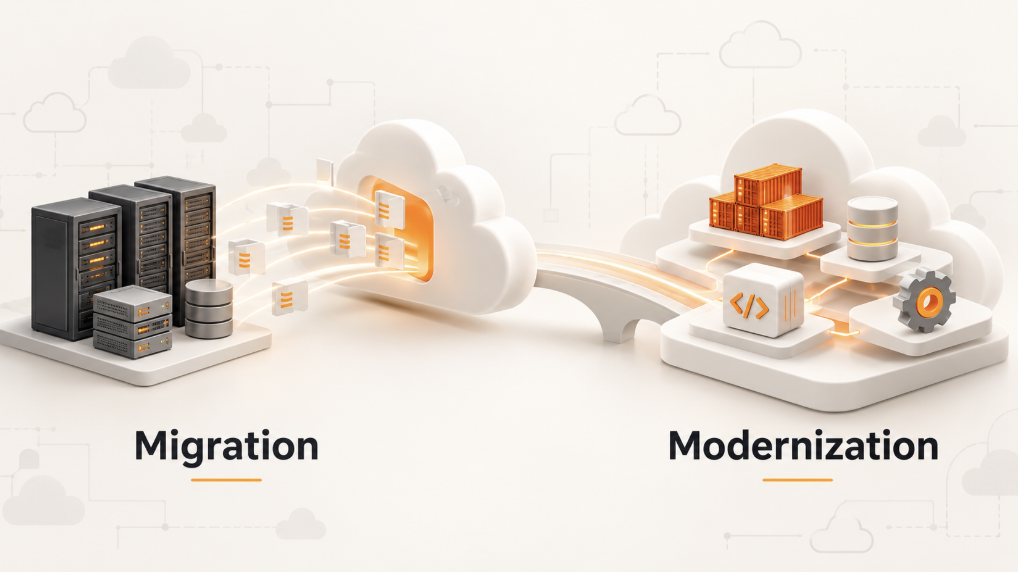
Migration is the process of moving applications, data, and infrastructure from on-premises environments or other cloud providers to AWS. Modernization goes beyond moving workloads to a new environment by transforming them to benefit from cloud-native capabilities such as container and serverless architectures.
Rather than applying the same approach to every workload, organizations should evaluate business objectives, technical dependencies, risks, and timelines together. AWS frames these decisions through the 7Rs:
Retire: Decommission applications that are no longer needed.
Retain: Keep workloads that are not yet ready for migration in their existing environment.
Rehost: Move applications to Amazon EC2 with minimal changes.
Relocate: Move workloads to the AWS equivalent of the same platform without changing the existing operating model or overall architecture.
Repurchase: Replace an existing application with a SaaS alternative.
Replatform: Make targeted improvements, such as migrating a self-managed database to Amazon RDS.
Refactor or Re-architect: Redesign an application using cloud-native services to improve agility, scalability, and performance.
Rehosting often provides a fast starting point. However, the long-term value of the cloud emerges when the right modernization steps are planned for each workload.
What Does the AWS Migration and Modernization Competency Validate?
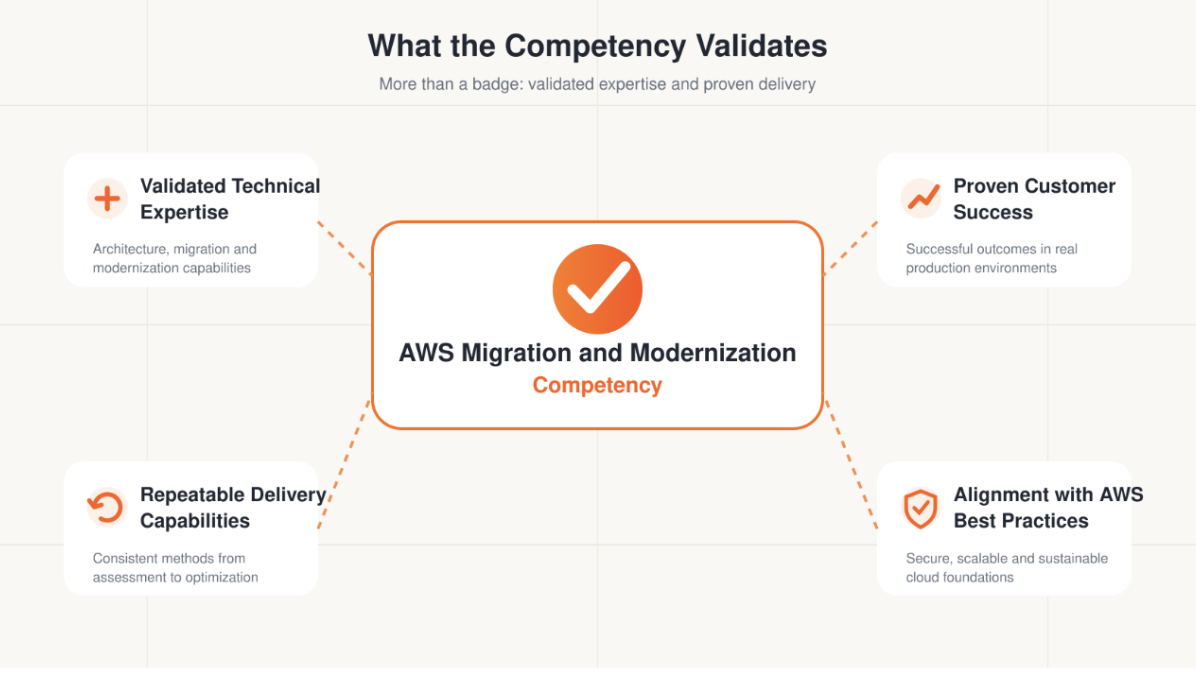
The AWS Competency Program validates the technical expertise and proven customer success of AWS Partners in specific solution areas. During the assessment process, AWS experts thoroughly review the partner’s knowledge, customer use cases, and delivery processes. The AWS Migration and Modernization Competency demonstrates not only a partner’s knowledge of AWS services but also its ability to plan, execute, and sustainably operate complex transformation projects.
For customers, this validation provides four key assurances:
Validated technical expertise: Teams have the technical capabilities required to manage migration and modernization processes.
Proven customer success: The approach has been successfully implemented in real customer environments.
Repeatable delivery capabilities: A defined and scalable delivery model is in place, from assessment through operations.
Alignment with AWS best practices: Architectures are designed according to security, resilience, performance, and cost optimization principles.
Why Is Working with an Experienced Partner Important?
One of the most critical decisions in a migration project is determining which workload should be moved, when it should be moved, and which strategy should be used. Incomplete dependency analysis, unrealistic migration wave plans, security controls being left until the final stages, or focusing solely on short-term migration goals can increase costs, downtime risks, and operational complexity.
A Competency Partner evaluates technical decisions alongside business priorities. This approach brings together the selection of the right 7R strategy, secure landing zone design, controlled cutover planning, and post-migration optimization within a single transformation plan.
How Does the Migration and Modernization Process Work?
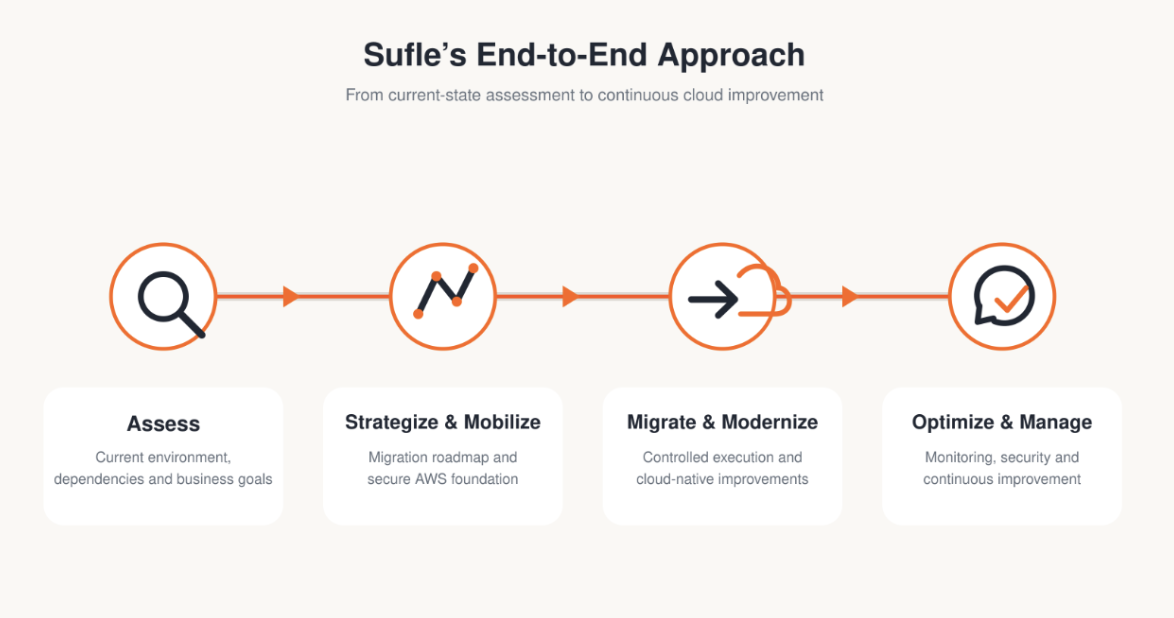
Assess: The existing environment, application dependencies, cost structure, and business objectives are analyzed. The appropriate migration strategy and prioritization are determined for each workload.
Mobilize: The landing zone is prepared, and the security, governance, and operating models are defined. Pilot workloads, migration waves, testing processes, and cutover plans are established.
Migrate and Modernize: Workloads are moved to AWS in controlled waves. Where appropriate, modernization is carried out using containers, managed databases, serverless services, and automation solutions.
Optimize and Manage: Following migration, security, performance, resilience, and cost are continuously monitored, while the platform evolves according to changing business needs.
Tools and programs such as AWS Transform, AWS Database Migration Service, and the AWS Migration Acceleration Program can support these stages. However, selecting the right tools is only one part of the process. It is equally important to sequence the transformation according to workload dependencies and business priorities.
Sufle’s End-to-End Approach
Sufle approaches migration and modernization projects not as one-time relocation efforts, but as end-to-end transformation processes focused on measurable business outcomes. Starting with the assessment phase, Sufle designs the target architecture, migration strategy, security requirements, and operating model as an integrated whole.
Throughout the project, Infrastructure as Code, CI/CD, container, and observability practices are treated as integral parts of the architecture. Following migration, security, operational reliability, and cost efficiency are continuously improved through Sufle’s Managed Services approach.
The AWS Migration and Modernization Competency demonstrates that Sufle has the technical expertise, repeatable delivery processes, and validated customer experience required to apply this approach in production environments.
How Is AI Changing Migration and Modernization Processes?
Agentic AI can help accelerate time-consuming activities such as discovery, dependency mapping, migration wave planning, and code transformation. With specialized capabilities that support infrastructure, application, and code transformation, AWS Transform can be used throughout the lifecycle—from assessment to continuous modernization.
However, AI cannot independently determine which strategy is right for each workload or how migration activities should be prioritized according to business needs. Experienced teams remain responsible for evaluating tool-generated outputs alongside security, regulatory, cost, and operational requirements.
How Can Organizations Determine the Right Time to Migrate?
The decision to migrate is often driven not only by a technical roadmap but also by a specific business need. The following signals may indicate that it is time to begin planning a transformation:
Infrastructure renewal requirements: Hardware is approaching the end of its lifecycle, or a data center contract is nearing expiration.
Licensing and operational costs: Virtualization and maintenance costs are increasing.
Growth and expansion into new markets: Existing capacity is struggling to meet demand.
AI and data objectives: Legacy applications and fragmented data structures are limiting new use cases.
Security and resilience requirements: The organization needs stronger governance, observability, and business continuity capabilities.
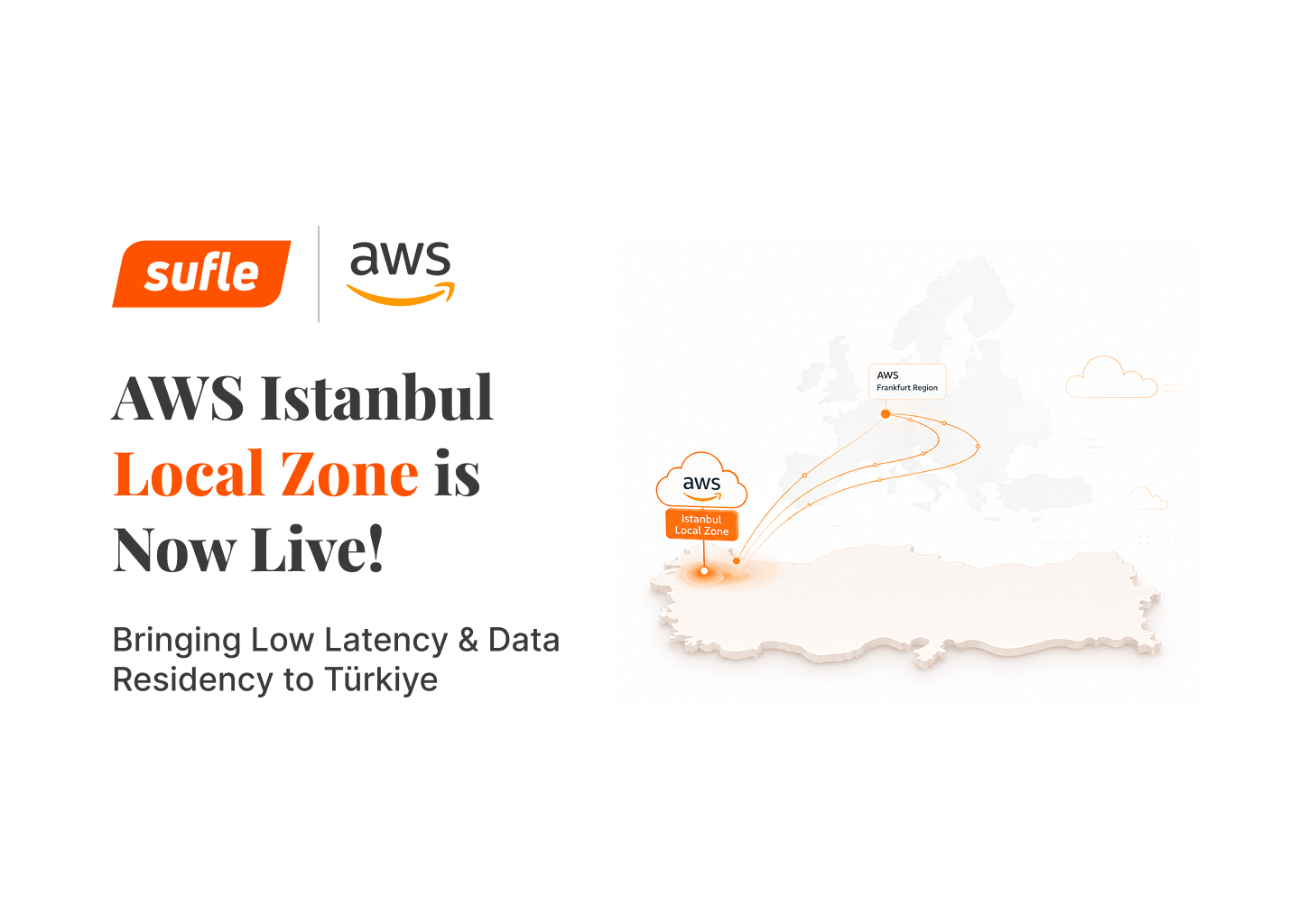
For latency-sensitive workloads in Türkiye, the AWS Local Zone in Istanbul, launched in May 2026, provides options to run selected compute, storage, and networking services closer to end users and process data within the country. However, suitability should be evaluated according to the services being used and the specific requirements of each workload.
Plan Your Migration and Modernization Journey with Sufle
Moving beyond Lift & Shift requires selecting the right strategy for each workload, planning migration waves according to business priorities, and establishing an architecture aligned with AWS best practices from day one.
As an AWS Advanced Tier Services Partner, AWS Managed Service Provider, and AWS Migration and Modernization Competency Partner, Sufle supports organizations throughout the entire journey—from assessment and migration planning to modernization with containers, serverless technologies, and AI-powered tools. Following migration, Sufle helps environments remain secure, optimized, and ready for future development through its Managed Services approach.
If you are planning an AWS migration or modernization journey, contact Sufle.
Frequently Asked Questions
What is the difference between Lift & Shift and modernization?
Lift & Shift, also known as rehosting, moves applications to AWS with minimal changes. Modernization improves the application or its operating model to benefit from cloud-native services such as containers, serverless technologies, and managed databases.
Is Lift & Shift still a valid strategy?
Yes. It can provide a fast first step, particularly when organizations are working within tight data center exit or contract timelines. However, in most cases, it is not the final destination. Long-term value emerges when workloads are enhanced with the appropriate modernization steps following migration.
Why is the AWS Migration and Modernization Competency important?
The Competency demonstrates that an AWS Partner’s technical expertise, customer success, and delivery capabilities in this field have been validated by AWS. This validation provides an important indicator of trust when selecting a partner for complex migration and modernization projects.
Resources

Are you looking to evaluate the right migration and modernization strategy for your business beyond Lift & Shift? Get in touch with Sufle to build a secure, scalable, and modern cloud infrastructure on AWS.