A Step-by-Step Move from On-Premises to AWS Cloud
 by Furkan Akça
25 Ağustos 202611 min read
by Furkan Akça


Let’s move to the cloud.
It sounds simple, but without proper planning, things can quickly become more complex than expected. Companies move to the cloud for different reasons: to reduce operational overhead, release products faster, or scale beyond the limits of their existing infrastructure. But moving to the cloud does not automatically deliver these benefits. Poor planning can lead to higher costs, performance issues, and more operational complexity.
Cloud migration is also more than moving servers from one environment to another. It changes how infrastructure is scaled, secured, and operated. Unlike traditional data centers built around fixed capacity, cloud environments can scale with demand and reduce unused resources when traffic drops.
Speed is another major advantage. Infrastructure that once took days or weeks to provision can be created in minutes through automation. For many companies, that agility matters just as much as cost savings.
The difference between a successful migration and a difficult one usually comes down to one thing: planning.
Visual 1: Migrating from On-Premises Infrastructure to AWS Cloud
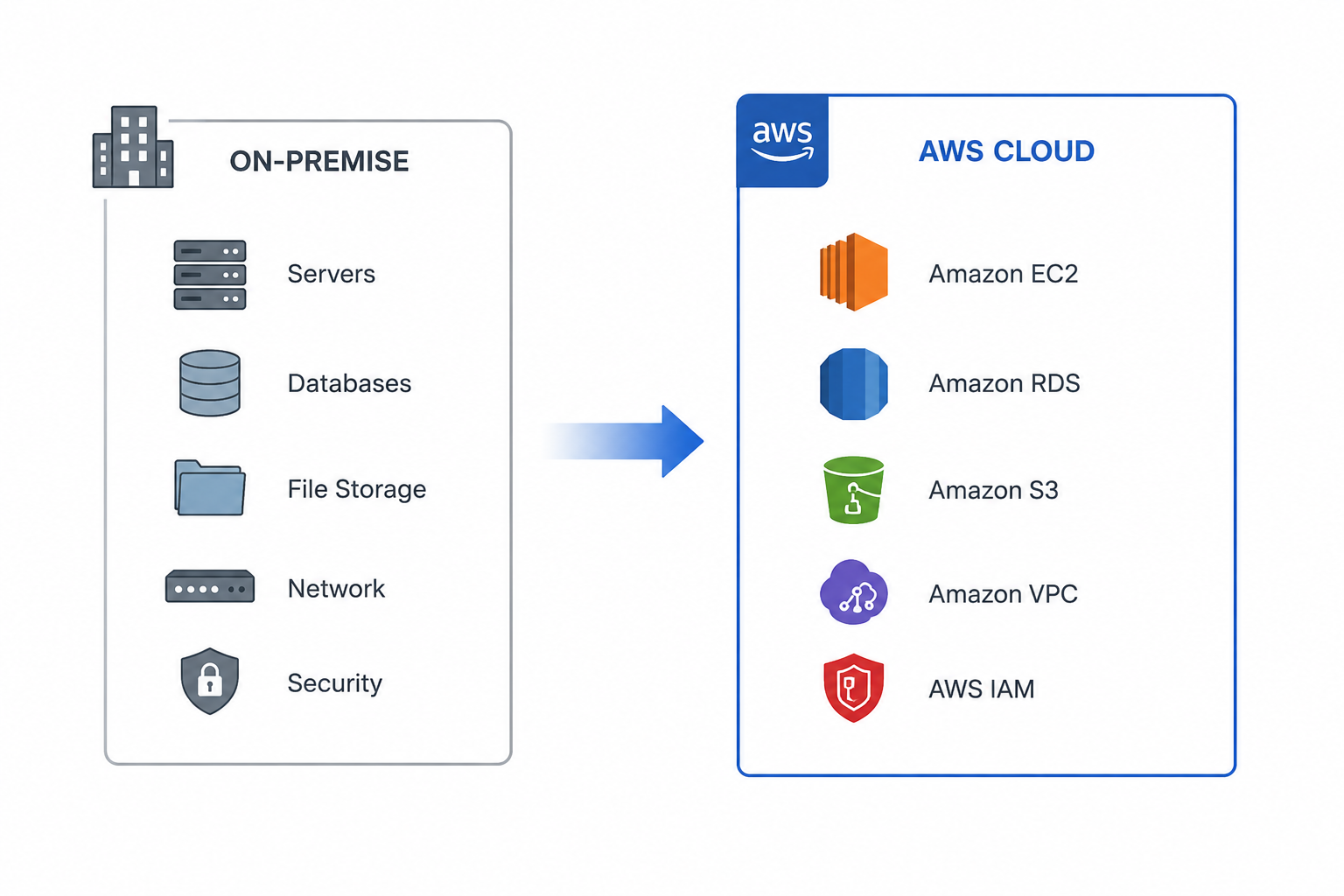 Servers, databases, storage, networking, and security components managed in an on-premises environment can be redesigned on AWS using services such as Amazon EC2, Amazon RDS, Amazon S3, Amazon VPC, and AWS Identity and Access Management (IAM). A successful migration aims not only to move existing components, but also to make the most effective use of the managed services available in the cloud.
Two companies may use similar technologies and operate with similar budgets, yet have very different migration outcomes. One may complete the transition smoothly, while the other struggles with performance and cost issues for months. The difference often lies not in the technology used, but in how the initial architectural decisions are made.
A common mistake is to lift the existing infrastructure into the cloud without adapting it to cloud-native design principles. The applications may continue to run, but the result is often higher resource consumption, unexpected costs, limited observability, and security gaps.
The cloud is not simply a copy of existing infrastructure hosted on the internet. It has its own operating model, security approach, and architectural principles. A migration process should therefore begin with the following questions:
Is the current architecture truly fit for purpose?
Which applications should be modernized?
Which applications can be migrated as is?
Will the environment we build remain sustainable in the years ahead?
AWS significantly simplifies infrastructure management through managed services across areas such as scaling, storage, databases, networking, security, and observability. Services including Auto Scaling, Elastic Load Balancing, Amazon RDS, Amazon S3, and Amazon CloudWatch address many of the operational requirements encountered in large-scale systems.
Visual 2: AWS Service Ecosystem
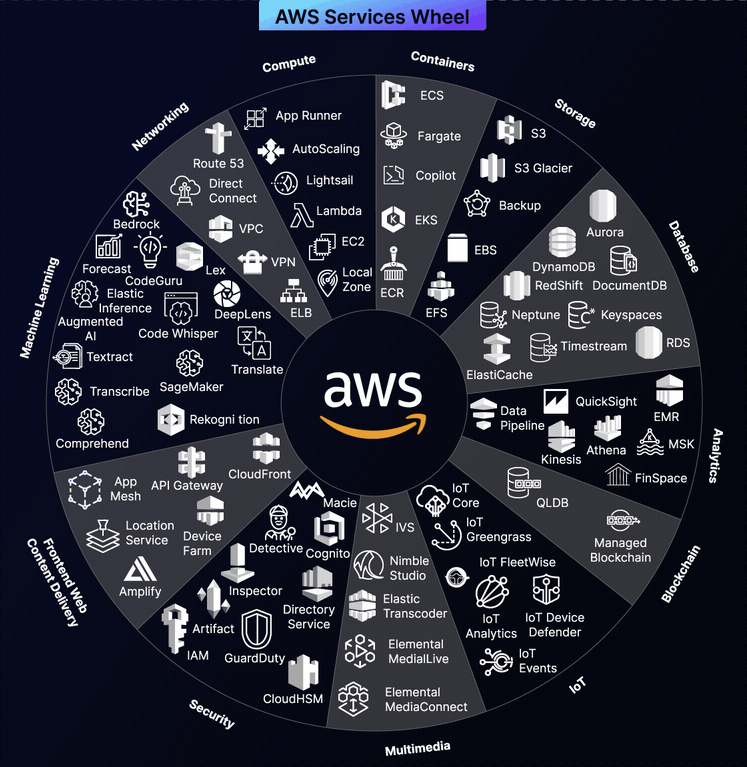
AWS offers hundreds of managed services across infrastructure, networking, security, databases, storage, analytics, containers, AI, and many other areas. A migration does not require using all of these services. What matters is selecting the services that best meet business needs and bringing them together within the right architecture.
However, using AWS alone does not guarantee a successful migration. A poorly designed application will continue to experience performance issues in the cloud. Costs may increase if resources are oversized, and existing risks may persist if security policies are not properly defined.
Real value emerges when AWS services are used in line with sound architectural principles.
When a decision is made to move to the cloud, teams usually begin with technical questions. Which EC2 instances should be used? How will the database be migrated? Should ECS or Kubernetes be preferred? How should the CI/CD process be designed? These questions are important, but a successful migration project does not start with them. The first step is to understand the current system. Without a complete view of your infrastructure, it is impossible to transform it into an environment that is more secure, efficient, or scalable.
AWS’s recommended approach follows the same principle. Migration is not the starting point of the process, but the natural outcome of effective analysis and planning. Cloud transformation is not merely a technical initiative for infrastructure teams; it is an organizational transformation that requires security, software development, operations, and finance teams to work together. The transformation is not limited to the servers; it also includes the operating model, security practices, and cost management.
The first step is to build an inventory of the existing infrastructure. Questions such as which applications are actively used, how services depend on one another, where critical data is stored, and when systems experience peak demand must be answered clearly. Business processes should be assessed alongside the technical environment. A reporting application may tolerate a short outage, while the same may be unacceptable for a payment platform or a critical system that handles customer transactions. Business criticality, data sensitivity, and availability expectations directly influence every decision, from architecture design to the migration plan.
AWS recommends assessing both technical and organizational readiness through the Migration Readiness Assessment (MRA) and the AWS Cloud Adoption Framework (AWS CAF). For example, without a standardized IAM management process, users and roles can become increasingly difficult to control over time. Similarly, without a resource tagging strategy, it may become difficult within a few months to determine which resources belong to which projects. Governance, security, and operational standards should therefore be established before applications are migrated.
Before moving production workloads, the foundational AWS environment should be established. Commonly built using AWS Control Tower, this environment is known as a Landing Zone. A Landing Zone brings together the AWS account structure, centralized identity management, security standards, logging, network design, and governance policies within a shared framework.
With AWS Organizations, environments such as production, testing, development, and shared services can be managed in separate AWS accounts. AWS IAM Identity Center provides centralized user and access management, while AWS CloudTrail and AWS Config help centrally monitor account activity and resource changes. Security standards can also be applied across accounts through AWS Control Tower controls.
This approach simplifies access management and cost tracking while reducing the risk that an incorrect change in one account will affect other environments.
Identity management is one of the core components of cloud security. Who can access which resources, what actions they can perform, and how those actions will be logged should be planned from day one. Centralized identity management, role-based access control, and the principle of least privilege should therefore form the foundation of the approach. Similarly, VPC design, subnet structure, internet access, NAT gateways, communication between services, and hybrid connectivity should be addressed as part of the initial architectural planning. A well-designed network architecture does more than improve performance; it also strengthens security and reduces operational complexity.
Every application has a different technical profile and business value. AWS therefore recommends the 7 Rs approach for migration projects. Some applications can be moved directly to the cloud without modification (Rehost), while others can be adapted to take advantage of cloud services (Replatform). Some infrastructure can be transferred to a different environment without changing its core architecture (Relocate), while strategically important applications may be completely redesigned (Refactor). Existing solutions may also be replaced with a different product or SaaS solution (Repurchase), systems that are no longer used may be decommissioned (Retire), or some workloads may remain in their current environment (Retain). The objective is not to apply the same method to every application, but to select the strategy that best aligns with each system’s business goals and technical requirements.
Visual 3: The AWS 7 Rs Migration Strategies
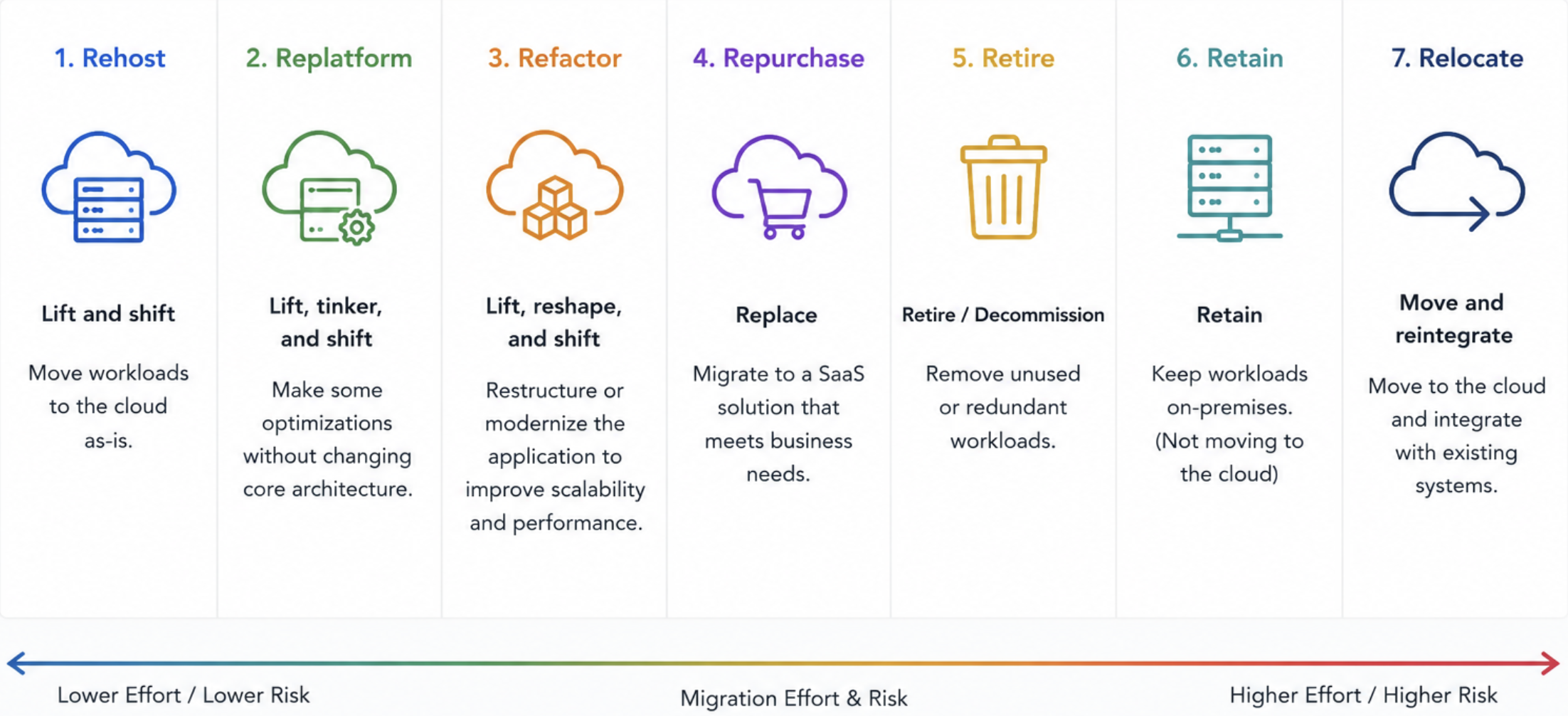
The AWS 7 Rs migration framework enables different migration strategies to be defined based on each application’s business requirements and technical characteristics. Not every application needs to move to the cloud in the same way. The right approach should be selected according to the application’s current state, business value, and long-term objectives.
Weeks of analysis are complete. The architecture has been designed, security policies have been established, and pilot migrations have been successful. The teams are now ready to move to production. Many people assume that migration day is the most difficult stage. In successful projects, however, the most intensive work happens before the applications are moved to AWS. If the planning has been done correctly, go-live largely consists of executing steps that have already been tested. Even so, incomplete analysis, insufficient testing, or decisions left until the last minute can turn the migration from a technical operation into a crisis-management exercise. Go-live should therefore be treated as a carefully planned and repeatedly validated operation.
In migration projects, the greatest challenge is often moving the data rather than the applications. Because production databases are continuously changing, taking a full backup and restoring it in the new environment is not enough; new records continue to be created in the legacy system while the migration is in progress. In large-scale projects, the existing data is therefore transferred to the target environment first, and subsequent changes are synchronized for a defined period. This minimizes the amount of data that must be transferred at go-live and significantly reduces downtime. Services such as AWS Database Migration Service (AWS DMS) simplify this process. Once the migration is complete, however, data integrity and expected application behavior must be thoroughly validated.
Everything may be technically ready. The applications may be running, the data migrated, and the tests completed. Yet the moment user traffic is redirected from the legacy environment to the new one remains the most critical stage of the migration. A planned maintenance window may be sufficient for some systems, while methods such as Blue/Green Deployment or Canary Deployment may be preferred for critical applications. This prevents all users from being redirected to the new environment at once, allowing traffic to be shifted gradually and potential issues to be detected at an early stage. The chosen method depends on technical requirements, business needs, and acceptable downtime. A reporting system may tolerate a short interruption, while even a few minutes of downtime may be unacceptable for an application that processes financial transactions.
Go-live is not the end of the project; it marks the beginning of a new phase. During the first few days, system behavior should be closely monitored, including CPU and memory usage, application response times, error rates, database performance, and network traffic. User experience should be assessed alongside infrastructure metrics. A migration cannot be considered truly successful without reviewing API performance, page load times, and user feedback together. A well-designed observability approach is therefore critical not only for identifying existing issues, but also for detecting potential problems before they affect users.
Postponing cost optimization until after the migration is a common mistake. Rightsizing, Auto Scaling policies, Savings Plans, and Reserved Instances should be considered as part of the architectural planning process. Disaster recovery should likewise not be left until after go-live. Backup strategies, replication models, and RTO and RPO targets should be defined in advance, and the resulting scenarios should be tested regularly.
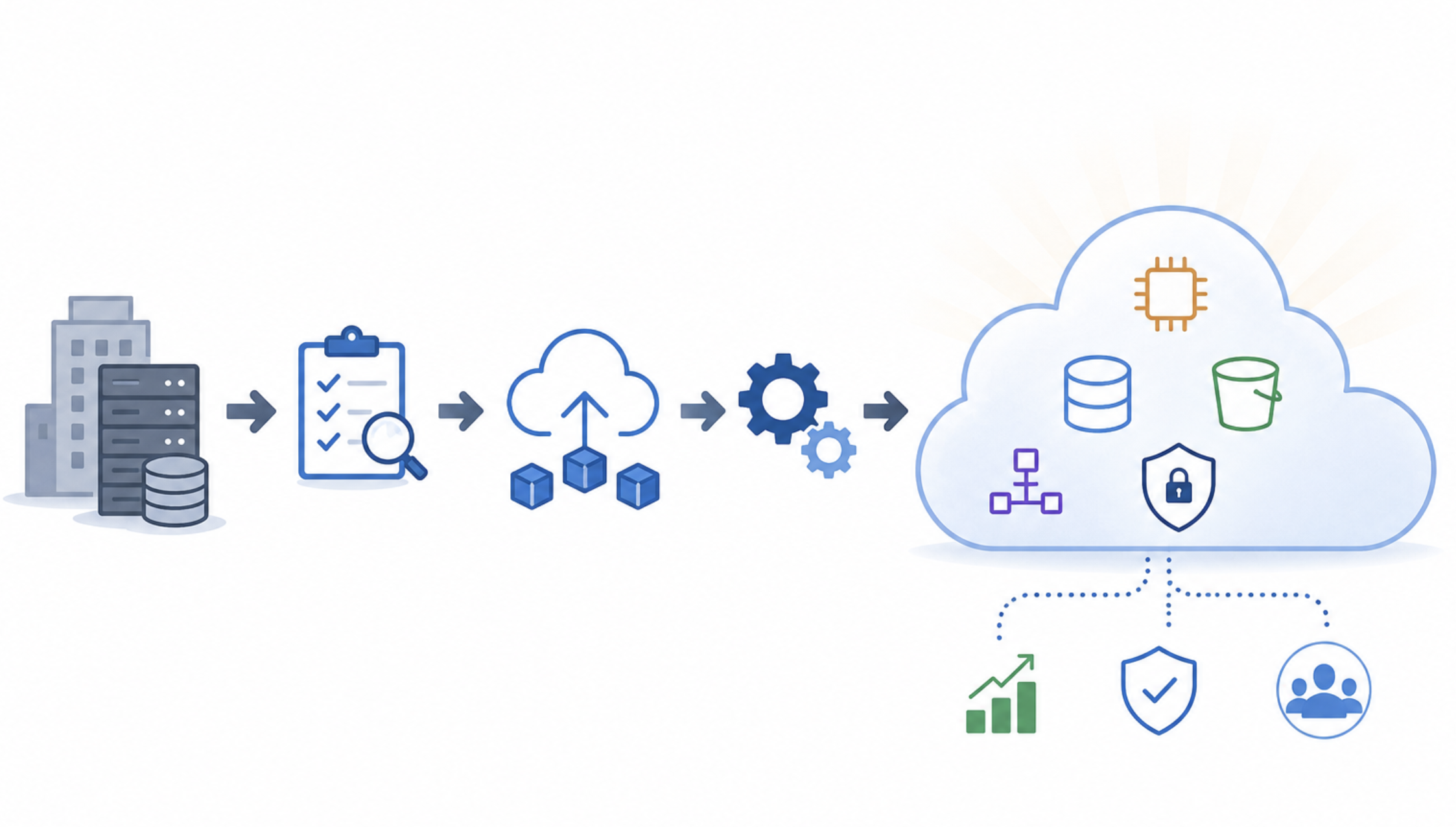
Visual 4: Overview of a Successful Cloud Migration Process
 Conclusion
Moving to the cloud means far more than transferring existing systems to a different environment. A successful migration project begins with accurate assessment, robust planning, and long-term architectural decisions. AWS offers powerful services and a mature ecosystem to support this transformation. True success, however, depends less on which services are used and more on how they are designed and managed to meet the company’s specific needs.
With a well-planned Landing Zone, the right security approach, a controlled migration strategy, and a culture of continuous improvement, the cloud becomes more than a new infrastructure environment. It becomes a strategic platform that enables companies to grow faster and adapt to changing needs.
Ultimately, a successful migration does not begin on the day the first EC2 instance is launched; it begins on the day the right plan is created.

Contact Sufle to plan your AWS migration with the right strategy, secure architecture, and a cloud environment tailored to your business needs.

Furkan is a graduate in Electrical and Electronics Engineering and a Cloud & Platform Engineer focused on AWS infrastructure, automation, observability, reliability, and scalable platform design. He works across cloud architecture, infrastructure operations, CI/CD, monitoring, security, and infrastructure-as-code to build secure, efficient, and resilient cloud environments.
Check out our latest updates and articles on our usage of technology, solutions and guidances.
We use cookies to offer you a better experience.