RAG vs Fine-Tuning: Choosing the Right Architecture for Production AI
 by Batuhan Şahin
6 Ekim 20268 min read
by Batuhan Şahin


When I first started working with LLMs, I thought I understood where RAG and fine-tuning fit into an AI application. I had already worked with semantic search, historical user data, custom prompts, and structured outputs. However, I later realized that one of the systems I considered to be RAG did not follow a complete RAG architecture. This experience led me to look at both approaches from a different perspective.
As a developer, there is a big difference between simply calling an LLM API and integrating an LLM into a production application.
An API call can give us an answer, but that answer may not always be the answer our application needs. It can be too general, follow the wrong format, operate outside the application's defined scope, or increase costs if usage is not properly controlled.
For me, "we added AI and it works" is not the goal.
The goal is to build an AI-powered application that produces useful and predictable results while following our application's rules and requirements.
This is where understanding approaches such as RAG and fine-tuning becomes important.
In this article, we will look at what these approaches actually solve, how they differ, and when each one can make sense in a production application.
Calling an LLM API is usually the easy part.
The challenge starts when we integrate it into a real application. Our application has its own data, business rules, security requirements, response formats, and cost constraints.
The LLM does not automatically know or follow these requirements.
For example, an AI assistant may need to answer questions using internal company documentation. If we simply send the question to an LLM, it may provide a reasonable answer, but it may not have access to the information our application actually needs.
This means we need to think about more than the model itself:
What information should the model access?
How should that information be retrieved?
What should the response look like?
How do we control cost and reliability?
A simple API call looks like:
Prompt -> LLM -> Response
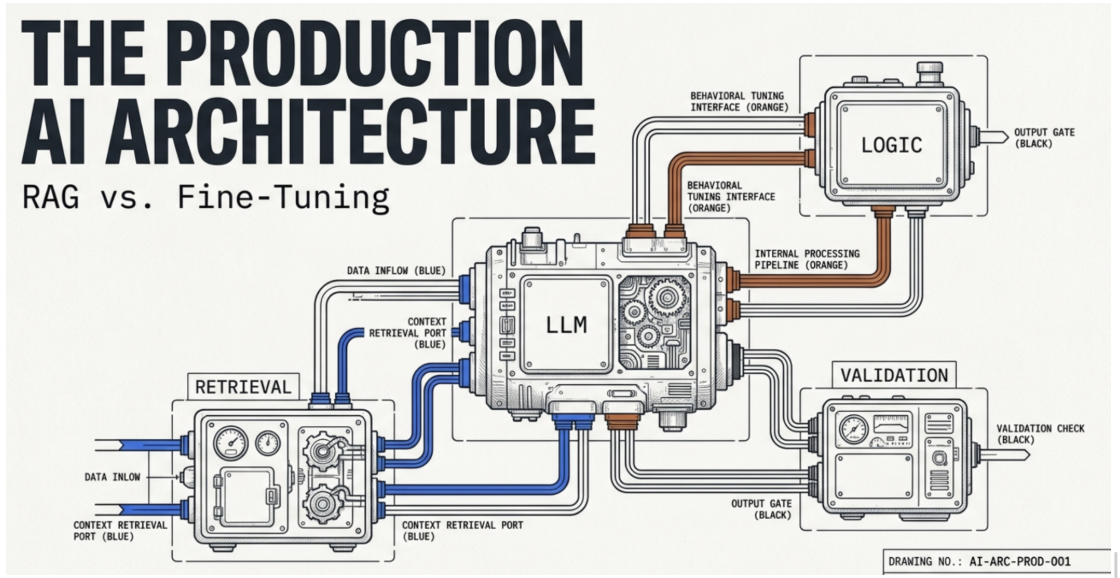
A production AI application is closer to:
User -> Application Logic -> Context or Retrieval -> LLM -> Validation -> Response
The LLM is only one part of the architecture.
This is where RAG and fine-tuning become useful: they help us solve different problems around how our application provides information to the model and how the model behaves.
RAG stands for Retrieval-Augmented Generation. It allows an LLM to use external information when generating a response.
Instead of sending only the user's question to the model, our application first retrieves relevant information and adds it to the prompt.
User Query -> Retrieve Relevant Information -> LLM -> Response
A common implementation uses embeddings and a vector database such as Pinecone. The embedding model represents text as vectors, which allows us to find information based on semantic similarity rather than exact keyword matches.
For example, a user might ask:
"How do I reset my password?"
The system can retrieve a document containing:
"If you forgot your password, you can create a new one from the login page."
That information is then provided to the LLM as context.
One important distinction is that using a vector database does not automatically mean we are using RAG. The retrieved information needs to be used as context for the LLM's response.
The same RAG architecture can also be built using managed AWS services.
For example, Amazon Bedrock Knowledge Bases can manage the RAG workflow while Amazon OpenSearch Serverless can be used as the vector store. Documents can be stored in a source such as Amazon S3, converted into embeddings, and indexed for semantic search.
A simplified architecture looks like this:
S3 → Bedrock Knowledge Base → Embeddings → OpenSearch Serverless
At runtime:
User Query → Bedrock Knowledge Base → Relevant Context → Foundation Model → Response
This approach allows us to use managed AWS services instead of building every part of the RAG pipeline ourselves. Amazon Bedrock Knowledge Bases handles the retrieval workflow and can augment the model prompt with the retrieved context.
Pinecone is still a valid alternative. In fact, Amazon Bedrock Knowledge Bases also supports Pinecone as a vector store, so the choice does not have to be either AWS-native or Pinecone-based.
In short, RAG mainly answers one question:
"What information should the model see when answering this request?"
Imagine we are building an internal AI assistant for a company.
The company has thousands of documents containing information about its products, internal processes, and technical guidelines. This information can also change over time.
If we simply ask an LLM:
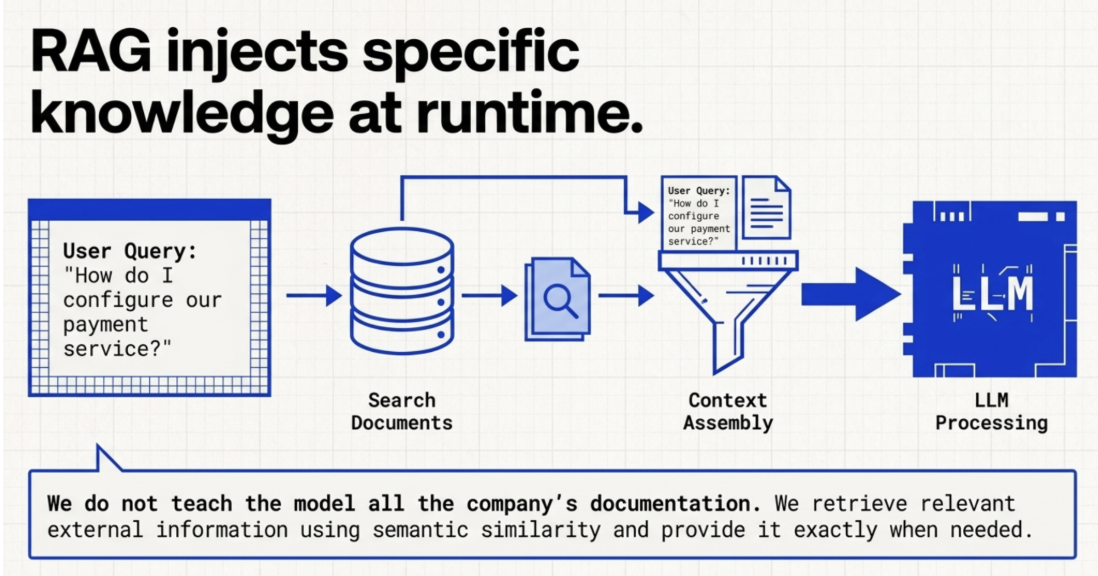
"How do I configure our payment service?"
the model may not have access to the company's latest documentation.
With RAG, the application can first search the relevant documents and provide the retrieved content to the LLM.
User Query -> Search Documents -> Relevant Context -> LLM -> Response
The model can then generate its answer based on the retrieved information.
The important part is that we are not trying to teach the model all of the company's documentation. We are giving it the information it needs at the time of the request.
This is one of the main differences between RAG and fine-tuning.
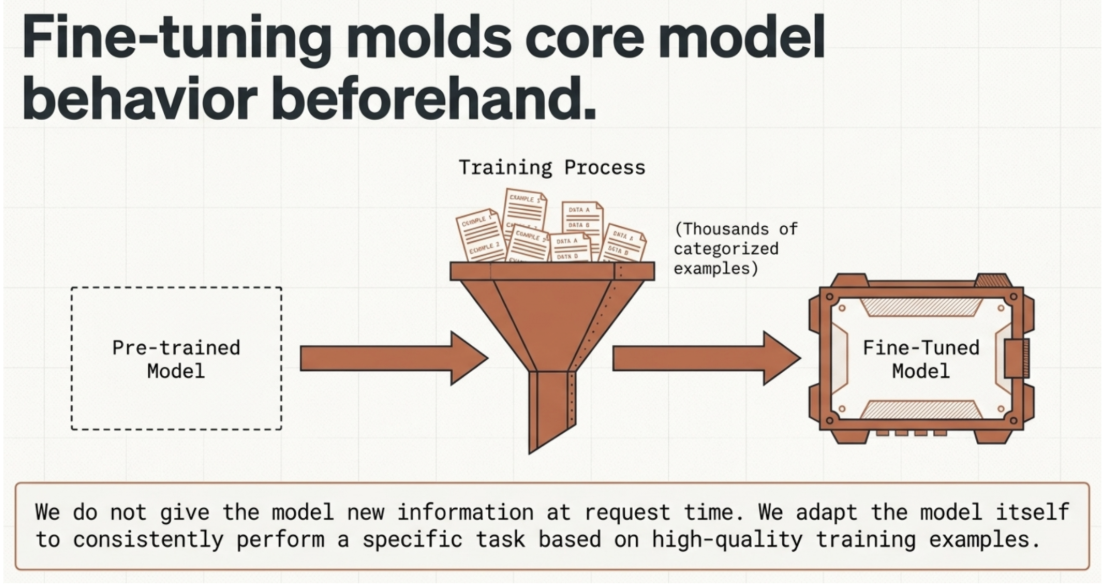
Fine-tuning is the process of adapting a pre-trained model for a more specific task or behavior by training it on additional examples.
Instead of giving the model new information at request time, we change how the model responds to certain types of inputs.
A simplified view looks like this:
Pre-trained Model + Training Examples -> Fine-tuned Model
For example, imagine we have thousands of examples showing how customer support messages should be categorized. We can use these examples to adapt a model to perform this specific classification task.
This is different from RAG.
With RAG, we retrieve information at runtime and provide it to the model.
With fine-tuning, we use training data to adapt the model itself.
A useful way to remember the difference is:
RAG: "What information should the model see?"
Fine-tuning: "How should the model behave?"
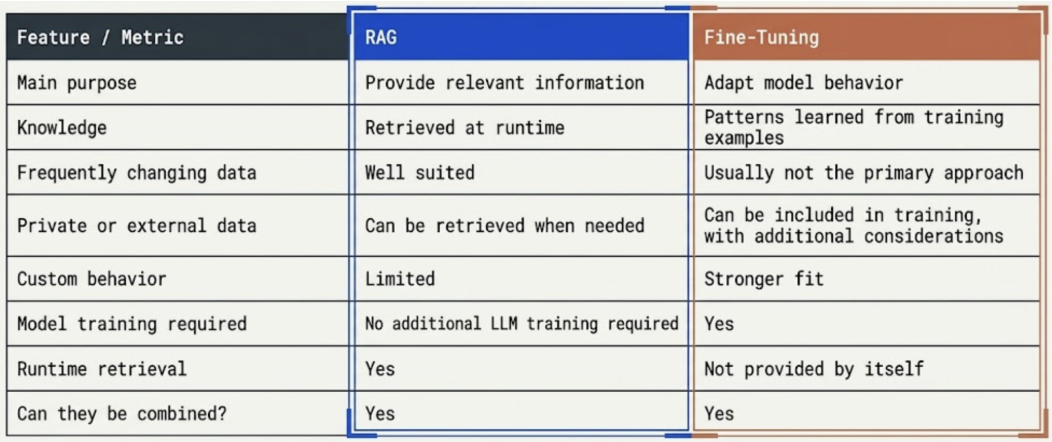
RAG and fine-tuning are often discussed as alternative ways to improve an LLM-powered application. However, they solve different problems.
A simple way to think about the difference is:
RAG changes what information the model can access and use for a particular request.
Fine-tuning changes how the model behaves.
For example, if our application needs to answer questions using frequently updated company documentation, RAG can provide the relevant information at runtime.
If the application needs to consistently perform a specific task based on many examples, fine-tuning may be worth considering.
And sometimes we need both.
An application can use RAG to provide the latest relevant information while using a fine-tuned model for a specific behavior or task.
The choice between RAG and fine-tuning depends mainly on the problem we are trying to solve.
Use RAG when the information changes frequently
Imagine an AI assistant that answers questions about a company's documentation.
The documentation changes regularly, so training the model every time a document changes would not be practical.
RAG allows us to retrieve the latest relevant information and provide it to the model at runtime.
Consider fine-tuning when behavior matters
Now imagine an application that needs to classify thousands of customer messages into predefined categories.
If we already have a large dataset of high-quality examples, fine-tuning can help the model adapt to this specific task.
The goal here is not to give the model constantly changing information. It is to make the model better suited to a particular task.
Use both when you need knowledge and specific behavior
Some applications need both.
For example, an AI support assistant might need access to the latest product documentation while also following a specific response style and classification process.
In this case, RAG can provide the relevant and up-to-date information, while fine-tuning can be used to adapt the model to the application's specific behavior.
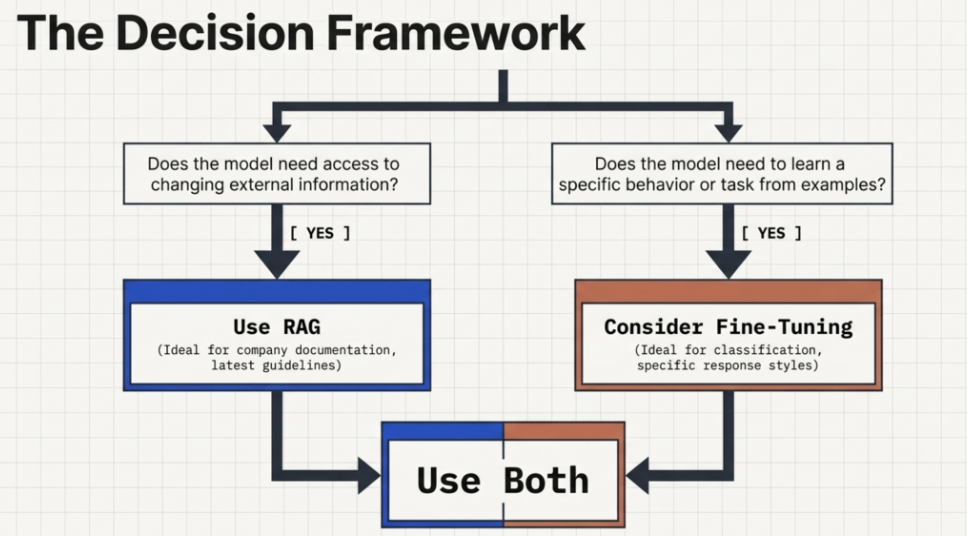
The decision can therefore start with two simple questions:
Does the model need access to changing external information?
Consider RAG.
Does the model need to learn a specific behavior or task from examples?
Consider fine-tuning.
If the answer to both is yes, a combination of the two may be appropriate.
RAG and fine-tuning solve different problems.
RAG helps us provide the right information to the model at runtime, while fine-tuning helps adapt the model to a specific task or behavior. In some applications, using both can make sense.
The main takeaway is that a production AI application is more than an LLM API call. We need to build the surrounding architecture around the model so that its responses fit our application's requirements.
Understanding what problem we are actually trying to solve is the first step toward choosing the right approach.

Planning an AI solution and unsure whether RAG, fine-tuning, or a hybrid approach is right for your use case? Contact Sufle to design a secure, scalable, and production-ready AI architecture on AWS.

Batuhan is a Full-Stack Software Engineer focused on building scalable web applications, cloud-native systems, and AI-powered solutions. He has experience across backend development, distributed systems, automation, and AWS cloud architectures, with a strong interest in building reliable and maintainable systems. He enjoys solving complex engineering challenges and turning ideas into practical solutions while continuously exploring cloud and AI technologies.
Check out our latest updates and articles on our usage of technology, solutions and guidances.
We use cookies to offer you a better experience.